
Post
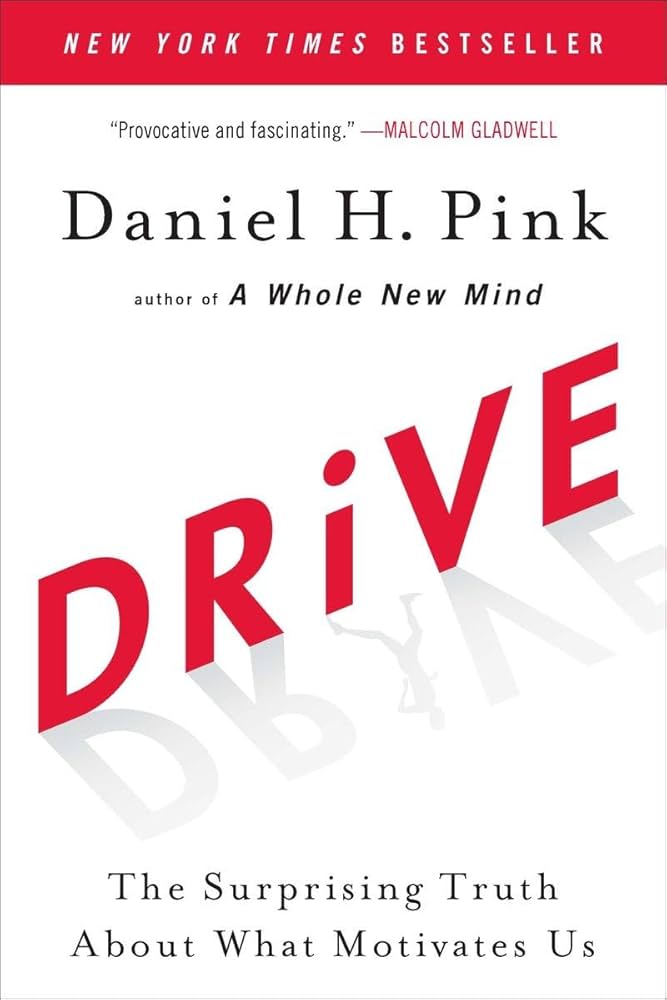
Drive – The Surprising Truth About What Motivates Us 1
May
Introduction: The Motivation Mismatch
For decades, the corporate world, educational institutions, and organizational leaders have operated under a simple, seemingly unshakeable premise: if you want people to perform better, you reward them with more money, recognition, or perks. Conversely, if you want to deter poor behavior, you punish them. This classic “carrot-and-stick” approach has been the bedrock of traditional management psychology since the dawn of the Industrial Revolution.
However, in his groundbreaking book, Drive: The Surprising Truth About What Motivates Us, bestselling author Daniel H. Pink argues that this traditional paradigm is not only outdated but deeply flawed. Drawing on four decades of scientific research on human motivation, Pink exposes a widening gap between what science knows and what business does. The central thesis of Drive is both provocative and liberating: the secret to high performance and satisfaction—at work, at school, and at home—is the deeply human need to direct our own lives, to learn and create new things, and to do better by ourselves and our world.
Pink systematically dismantles the old structures of motivation and introduces a new framework built around three core elements: Autonomy, Mastery, and Purpose. This book is not just a theoretical critique of modern business; it is an urgent, actionable manifesto for a complete overhaul of how we organize our societies, lead our teams, and live our daily lives.
The Evolution of Motivation: From 1.0 to 3.0
To help readers understand how we arrived at our current predicament, Pink uses a clever operating system analogy to track the history of human motivation.
       [ Motivation 1.0 ]  -->  Biological Survival (Food, Water, Shelter)
               |
               v
       [ Motivation 2.0 ]  -->  External Rewards & Punishments (Carrots & Sticks)
               |
               v
       [ Motivation 3.0 ]  -->  Intrinsic Drive (Autonomy, Mastery, Purpose)
Motivation 1.0: Preserving the Species
In the earliest days of human history, our primary operating system was purely biological. Motivation 1.0 was driven entirely by survival instincts. It was about securing food, finding water, seeking shelter, and avoiding predators. It served humanity well for millennia, but as civilization evolved and became more cooperative, this basic code became insufficient.
Motivation 2.0: The Carrot and the Stick
As societies structured themselves around agriculture, commerce, and eventually industrial manufacturing, a new operating system was required. Enter Motivation 2.0. This system recognized that humans are more than just biological creatures; we are also responsive to external incentives.
This model assumed that humans seek to maximize reward and minimize pain. In the factory era, this worked exceptionally well. If you paid a worker based on how many widgets they produced, they would produce more widgets. Management became a mechanism of control, ensuring compliance through a system of carrots (bonuses, promotions) and sticks (demotions, terminations).
The Fatal Flaws of Motivation 2.0
While Motivation 2.0 was highly effective for routine, repetitive, algorithmic tasks, Pink explains that it falls spectacularly short in the modern economy. Today’s work is increasingly heuristic—it requires creative thinking, problem-solving, and conceptual synthesis rather than mechanical repetition.
When organizations apply “if-then” rewards (e.g., “If you do this, then you will get that”) to creative, heuristic tasks, it often backfires. Pink highlights several distinct collateral damages caused by an overreliance on carrots and sticks:
Extinguishing Intrinsic Motivation: External rewards can turn play into work. Once an activity becomes tied to an external payout, people lose interest in the activity for its own sake.
Diminishing Performance: Studies show that when tasks require even basic cognitive skills, offering a larger financial incentive frequently leads to worse performance. The pressure of the high reward narrows the focus, choking creativity.
Crushing Creativity: If-then rewards force people to focus on a narrow path to a specific prize, preventing them from exploring peripheral, creative solutions.
Crowding Out Good Behavior: Tangible rewards can inadvertently discourage altruism and ethical behavior.
Encouraging Cheating and Short-Term Thinking: When the reward becomes the only goal, people will often take the shortest, most unethical path to achieve it.
Becoming Addictive: Cash bonuses can operate like a drug; once offered, the recipient requires larger and more frequent doses to achieve the same motivational effect.
Motivation 3.0: The Upgrade We Need
Because the nature of work has changed from routine to creative, Pink argues that we need an immediate upgrade to Motivation 3.0. This system is designed around Intrinsic Motivation—the desire to do something because it is inherently deeply interesting, challenging, or absorbing.
The Three Pillars of Motivation 3.0
The core of Drive is dedicated to exploring the three fundamental pillars that power Motivation 3.0. When these three elements are present, individuals do not need to be managed or bribed; they are self-propelled.
| Pillar | Core Definition | Key Impact |
| Autonomy | The desire to direct our own lives. | Increases engagement over mere compliance. |
| Mastery | The urge to get better and better at something that matters. | Sustains long-term effort and resilience. |
| Purpose | The yearning to do what we do in the service of something larger than ourselves. | Provides context, meaning, and ethical boundaries. |
1. Autonomy
Pink asserts that the concept of “management” is an outdated technology designed to ensure compliance. If we want engagement, we must replace management with autonomy. Autonomy is not about isolation or a lack of accountability; it is about self-direction.
Pink breaks autonomy down into four distinct dimensions, known as The Four Ts:
Task: People need autonomy over what they do. Pink points to companies like 3M and Google, which famously allowed engineers to spend 15% to 20% of their time working on any project of their choosing. This autonomy gave birth to iconic products like Post-it Notes and Gmail.
Time: People need autonomy over when they do it. The book highlights the Results-Only Work Environment (ROWE), where employees do not have set hours or mandatory office attendance. They are judged solely on their output. In ROWE environments, productivity often spikes, and turnover plummets.
Technique: People need autonomy over how they do their work. Instead of micro-managing employee methods with rigid scripts and procedures, leaders should define the desired outcome and let individuals find their own path to get there.
Team: People need autonomy over who they work with. While harder to implement in traditional structures, allowing employees some say in assembling their project teams or hiring their peers fosters deeper collaboration and mutual respect.
“Management isn’t about walking around and seeing if people are in their offices. It’s about creating conditions for people to do their best work.” — Daniel H. Pink
2. Mastery
While Motivation 2.0 demands compliance, Motivation 3.0 demands engagement. Only engagement can produce mastery—the desire to improve continuously at a skill or craft that matters.
Pink draws heavily on the work of psychologist Mihaly Csikszentmihalyi, particularly the concept of “Flow.” Flow is the state of optimal frustration and focus where a task is neither too easy (which causes boredom) nor too difficult (which causes anxiety). It is the sweet spot where time seems to disappear, and we are entirely consumed by the task at hand.
To achieve mastery, Pink outlines three fundamental laws:
Mastery is a Mindset: It requires viewing abilities not as fixed traits but as capacities that can be developed through effort and practice (aligning with Carol Dweck’s Growth Mindset theory).
Mastery is a Pain: It requires grit, discipline, and effort. It is not always fun or easy; it demands pushing through plateaus and experiencing frustration.
Mastery is an Asymptote: You can approach it, you can get incredibly close to it, but you can never fully reach it. The joy of mastery is in the lifelong pursuit of perfection, knowing it can never be fully attained.
3. Purpose
The first two pillars—Autonomy and Mastery—are incredibly powerful, but they require a third to give them direction. That pillar is Purpose.
Pink argues that human beings are naturally “purpose maximizers,” not just “profit maximizers.” When the desire to do something greater than oneself is removed, people lose their moral compass and long-term fulfillment. While profit is a necessary catalyst for business survival, it cannot be the sole driver of human passion.
Pink shows that when an organization connects its daily operations to a broader, meaningful social objective, employees are vastly more motivated. Purpose expresses itself in three ways within an organization:
Goals: Using profit to reach purpose, rather than using purpose just to achieve profit.
Words: Shifting corporate language away from purely transactional terms toward words that emphasize community, dignity, and human progress.
Policies: Allowing employees to bring their personal values to work, ensuring that corporate actions align with social responsibilities.
Type I vs. Type X
Throughout the book, Pink categorizes human behavior into two distinct types:
Type X (Extrinsic): Behavior that is fueled more by external rewards and validation than by the inherent satisfaction of the activity. Type X behavior is learned, not innate, and is the default setting of the Motivation 2.0 operating system.
Type I (Intrinsic): Behavior that is fueled by internal desires—the pursuit of autonomy, mastery, and purpose. Type I behavior is self-sustaining, healthier for psychological well-being, and ultimately more successful in the long run.
Pink emphasizes that Type I individuals almost always outperform Type X individuals over a sustained period. Because they are driven by internal fires, they possess greater resilience, higher cognitive flexibility, and a much lower rate of burnout. Crucially, Pink notes that Type I behavior can be learned. No one is permanently locked into being a Type X person; with the right changes in environment and mindset, anyone can awaken their intrinsic drive.
The “Toolkit” for Implementation: Drive – The Surprising Truth About What Motivates Us 1
What separates Drive from many other business books is its highly practical, actionable conclusion. Pink includes a comprehensive “Toolkit” section designed to help individuals, managers, educators, and parents apply Motivation 3.0 principles to everyday life.
For Individuals: The One-Sentence Strategy
Pink suggests adapting a strategy used by U.S. President Clare Boothe Luce: define your life by a single sentence. What is your sentence? Is it: “He raised three happy, confident children”? Or perhaps: “She invented a technology that made clean water accessible to millions”? By distilling your life’s purpose into a single sentence, you gain instant clarity on where to direct your daily energy and autonomy.
For Managers: The “FedEx Day”
To foster autonomy, Pink encourages companies to run “FedEx Days.” On a FedEx Day, employees are given 24 hours to work on absolutely anything they want, with only one catch: they must deliver (thus “FedEx”) a prototype, an idea, or a solution to their colleagues the very next day. This simple exercise often yields more innovative breakthroughs than months of traditional, top-down brainstorming sessions.
For Parents and Educators: Praise Effort, Not Intelligence
To foster a mastery mindset in children, Pink advises changing how we offer praise. Instead of praising a child’s innate intelligence (“You’re so smart!”), which reinforces a fixed mindset, we should praise their effort, strategy, and persistence (“I can see how hard you worked on this project, look how much you’ve improved!”).
Conclusion: A Blueprint for the Future
Daniel H. Pink’s Drive: The Surprising Truth About What Motivates Us is a masterful synthesis of behavioral science and practical management philosophy. It serves as a stark wake-up call to an archaic corporate world that remains stubbornly addicted to the carrot-and-stick approach.
The book’s ultimate power lies in its optimism. Pink reminds us that our deepest, most authentic motivation is not driven by fear of punishment or greed for money. Instead, it is driven by our intrinsic human desire to grow, to create, to be self-directed, and to leave the world a little better than we found it.
By building our workplaces, schools, and personal habits around Autonomy, Mastery, and Purpose, we can unlock an unprecedented wave of creativity, productivity, and genuine human happiness. Drive is not merely a book you read; it is a framework you live by. It is essential reading for any leader looking to inspire a modern team, any educator aiming to spark a love of learning, and anyone seeking to reclaim their own internal spark.
