
Post
Kafka on the Shore – A Surreal Journey Between Reality and Imagination
May
Kafka on the Shore – A Surreal Journey Between Reality and Imagination
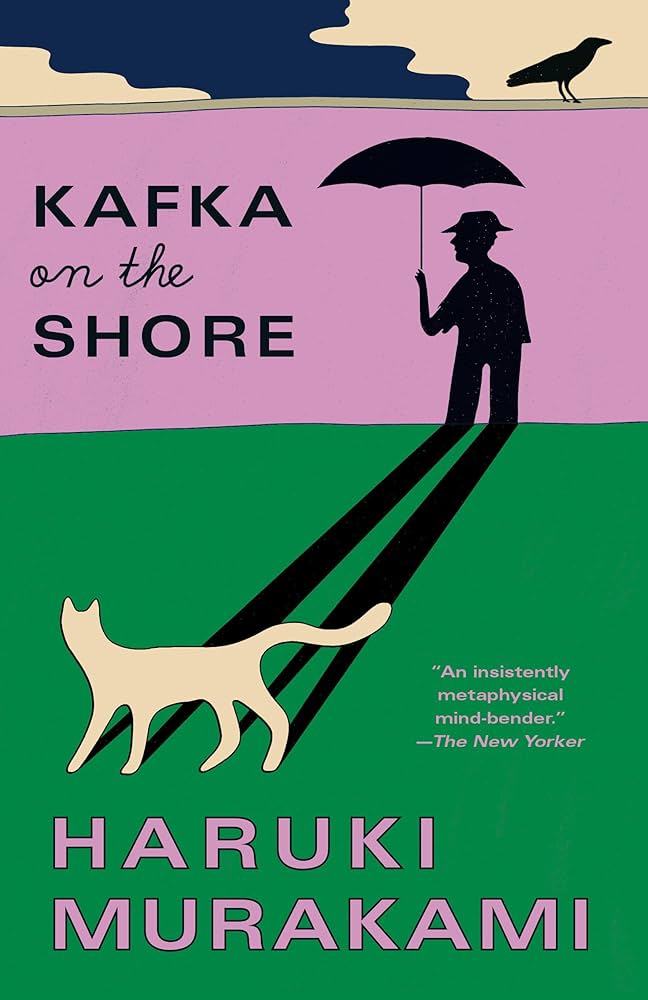
Kafka on the Shore: A Surreal Journey Between Reality and Imagination by Haruki Murakami is a mesmerizing, genre-defying novel published in Japan in 2002 and in English translation in 2005. Widely regarded as one of Murakami’s masterpieces, it stands alongside Norwegian Wood and 1Q84 as one of his most ambitious and philosophically rich works. Blending elements of magical realism, detective fiction, Greek tragedy, and metaphysical fantasy, the book creates a hypnotic dreamscape where the boundaries between reality and imagination, past and present, and consciousness and the subconscious dissolve.
At its heart, Kafka on the Shore is a coming-of-age story, a quest for identity, and a profound meditation on fate, memory, responsibility, and the search for meaning in a chaotic universe. Murakami himself described the novel as an attempt to explore “the world of the unconscious.” The result is a book that feels both deeply personal and universally resonant, inviting readers to surrender to its strange logic rather than demand conventional explanations.
Dual Narratives: Two Souls on Parallel Paths
The novel unfolds through two alternating storylines that gradually intertwine in mysterious and inevitable ways.
The first follows Kafka Tamura, a precocious and brooding 15-year-old boy who runs away from his Tokyo home on his fifteenth birthday. Kafka is haunted by a prophetic curse from his absent father and carries the heavy burden of an Oedipal prophecy. Equipped with a love for books and a strong will, he travels to the distant city of Takamatsu, where he finds refuge in a private library run by the elegant Miss Saeki and her assistant Oshima. Kafka’s journey is both literal and symbolic — a flight from destiny that paradoxically leads him straight into its arms.
The second narrative centers on Nakata, an elderly man in Tokyo who has lived with cognitive impairments since a strange incident during World War II. As a child, Nakata lost much of his memory and intelligence but gained the extraordinary ability to speak with cats. After a shocking event involving a cat-killing sociopath, Nakata embarks on his own odyssey, guided by an inexplicable inner compass. Simple, kind, and profoundly innocent, Nakata becomes an unlikely hero whose actions ripple across reality in ways he cannot comprehend.
As the stories progress, dreams, prophecies, fish falling from the sky, and encounters with ghosts and historical figures blur the line between the two protagonists. Murakami masterfully maintains narrative tension while slowly revealing that these seemingly separate lives are connected on a much deeper, almost cosmic level.
Major Themes: Destiny, Memory, and the Unconscious: Kafka on the Shore – A Surreal Journey Between Reality and Imagination
One of the novel’s central preoccupations is the tension between fate and free will. Kafka desperately tries to escape the prophecy that defines him, yet every step he takes seems to fulfill it. Murakami suggests that while destiny may exist, how we respond to it — with courage, acceptance, or denial — remains within our control.
Memory and identity form another crucial layer. Both Kafka and Nakata are fragmented individuals searching for wholeness. Nakata’s lost memories represent a collective as well as personal amnesia, while Kafka’s journey involves confronting the shadows within his own psyche. The novel asks: How much of who we are is determined by what we remember, and what we choose to forget?
Sexuality, love, and loneliness are explored with Murakami’s characteristic frankness. Several scenes involving Kafka are sexually explicit and psychologically complex, touching on incestuous undertones, adolescent confusion, and the healing (or destructive) power of physical intimacy. Love in the book is rarely simple; it often arrives wrapped in mystery, age gaps, or metaphysical dimensions.
The boundary between reality and imagination is constantly questioned. Ghosts appear as real as living people. Dreams bleed into waking life. Murakami uses these surreal elements not for cheap thrills, but to suggest that the invisible world — the realm of the unconscious, archetypes, and collective memory — exerts enormous influence on our everyday existence.
Another recurring motif is responsibility and guilt. Characters must come to terms with actions taken (or not taken) in the past. Nakata’s simple goodness contrasts with more complicated moral failures, forcing readers to consider what it means to live ethically in an absurd world.
Style, Symbolism, and Musicality
Murakami’s prose in Kafka on the Shore is fluid, atmospheric, and deceptively simple. He employs short chapters, precise details, and rhythmic repetition to create a trance-like reading experience. Pop culture references — to Beethoven, John Coltrane, Kafka’s own writings, and Japanese comic books — ground the surreal elements in contemporary life.
Cats play a significant symbolic role, representing independence, mystery, and the ability to move between worlds. The library itself becomes a sanctuary and a portal. Rain, water, forests, and stones carry layered meanings related to purification, memory, and the eternal.
The novel’s structure — alternating perspectives, time shifts, and parallel realities — mirrors its themes. Readers must actively participate in constructing meaning, much like the characters interpret omens and signs.
Reception and Criticisms
Kafka on the Shore received widespread critical acclaim and numerous literary awards in Japan. Internationally, it solidified Murakami’s reputation as a global literary superstar. Many readers describe the book as life-changing, citing its ability to evoke profound emotional and philosophical responses.
However, it has also faced criticism. Some reviewers argue that the novel is overly long, meandering, or leaves too many questions unanswered. The explicit sexual content involving a minor has disturbed certain readers. Others find the blend of high literature and pop culture gimmicky or pretentious. Detractors sometimes claim Murakami’s female characters serve primarily as vehicles for male self-discovery.
Despite these points, the book’s imaginative power and emotional depth have earned it a dedicated following. It continues to be studied in universities for its postmodern techniques and existential themes.
Why Kafka on the Shore Matters in 2026
In an increasingly fragmented, digital, and uncertain world, Murakami’s exploration of the unconscious feels more relevant than ever. As artificial intelligence blurs the line between human and machine consciousness, and as society grapples with collective trauma, misinformation, and existential anxiety, the novel’s questions about reality, identity, and meaning resonate powerfully.
Young readers particularly connect with Kafka’s rebellion and search for selfhood amid family dysfunction and societal pressure. In the age of social media, where curated identities dominate, the book’s emphasis on confronting inner shadows offers a necessary counterbalance.
Its treatment of mental fragmentation and healing also speaks to growing awareness around trauma, dissociation, and psychological integration. The novel suggests that wholeness comes not from denying darkness but from integrating it — a message with therapeutic as well as literary value.
Final Reflections
Kafka on the Shore is ultimately a novel about courage — the courage to face one’s demons, to accept responsibility for one’s life, and to keep moving forward even when the path makes no rational sense. It reminds us that some journeys matter more for their transformative effect on the traveler than for any tangible destination.
Murakami does not provide easy answers or tidy resolutions. Instead, he offers something more valuable: an invitation to dwell in mystery, to listen to the quiet voices within, and to recognize that reality is far stranger and more interconnected than we usually admit.
As one character tells Kafka, “Sometimes fate is like a small sandstorm that keeps changing directions. You change direction but the sandstorm chases you. You turn again, but the storm adjusts.” The only way through, the novel suggests, is to keep walking.
For anyone who has ever felt lost between who they are and who they might become, between the world they see and the one they sense beneath it, Kafka on the Shore offers profound companionship. It is a book that lingers in the mind long after the final page, much like a vivid dream that continues to shape your waking thoughts.
In the end, Haruki Murakami has created more than a novel — he has crafted a mirror for the soul. Reading Kafka on the Shore is not merely an act of consumption. It is a journey you take with the author, into the deepest parts of yourself, where reality and imagination dance together in eternal, enigmatic harmony.
