Post
The 7 Habits of Highly Effective People – A Powerful Guide to Personal and Professional Effectiveness
May
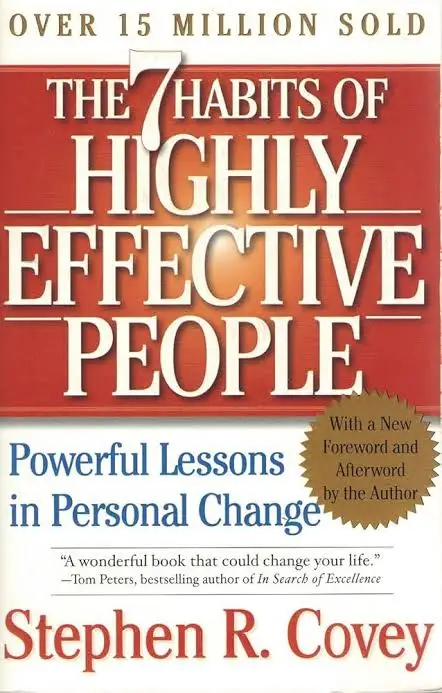
The 7 Habits of Highly Effective People: A Powerful Guide to Personal and Professional Effectiveness by Stephen R. Covey is one of the most influential self-help and leadership books ever written. First published in 1989, it has sold over 40 million copies worldwide and remains a cornerstone of personal development literature. Unlike many books that focus on quick fixes or superficial techniques, Covey presents a holistic, principle-centered approach to effectiveness that emphasizes character, integrity, and long-term growth.
Covey, a renowned educator, author, and businessman, argues that true success comes from aligning one’s life with timeless universal principles rather than relying on personality techniques or shortcuts. The book’s central message is that effectiveness is achieved from the “inside out” — by first changing ourselves before attempting to change our circumstances or others. Its structured framework has helped millions of readers in business, education, families, and personal lives create meaningful, sustainable success.
Paradigm Shift: From Personality Ethic to Character Ethic: The 7 Habits of Highly Effective People
Covey begins by distinguishing between two approaches to success
- The Personality Ethic (popular since the 1920s) focuses on external traits — public image, communication skills, positive attitudes, and quick-fix techniques.
- The Character Ethic focuses on foundational principles such as integrity, humility, courage, justice, patience, and the Golden Rule.
He asserts that while personality techniques may bring short-term success, lasting effectiveness requires strong character. This “inside-out” paradigm shift is the foundation for the entire book. Real change begins with how we see the world (our paradigms), then moves to how we act.
The 7 Habits: An Overview: The 7 Habits of Highly Effective People
Covey organizes the habits into three stages of maturity: Dependence → Independence → Interdependence.
Private Victory (Habits 1–3): Moving from Dependence to Independence
Habit 1: Be Proactive The foundational habit. Proactive people focus on their Circle of Influence (things they can control) rather than their Circle of Concern (things they cannot control). They take responsibility for their choices, responses, and attitudes. Covey introduces the idea that between stimulus and response, there is a space to choose. This habit empowers readers to stop blaming external factors and start shaping their own destiny.
Habit 2: Begin with the End in Mind This habit is about vision and purpose. Covey encourages readers to imagine their own funeral and consider what they would want people to say about them. By defining personal values and creating a personal mission statement, individuals can ensure their daily actions align with their long-term goals. It emphasizes living by design rather than by default.
Habit 3: Put First Things First The habit of time management and prioritization. Covey introduces his famous Time Management Matrix, dividing tasks into four quadrants based on urgency and importance. Highly effective people focus on Quadrant II (important but not urgent) activities such as planning, relationship-building, and self-renewal. This habit teaches how to organize and execute around priorities.
Public Victory (Habits 4–6): Moving from Independence to Interdependence, The 7 Habits of Highly Effective People – A Powerful Guide to Personal and Professional Effectiveness
Habit 4: Think Win/Win This habit promotes a mindset of mutual benefit. Instead of win/lose (competitive) or lose/win (accommodating) paradigms, Covey advocates for solutions where everyone wins. It requires high courage and consideration. Win/Win is supported by three key elements: character, relationships, and agreements.
Habit 5: Seek First to Understand, Then to Be Understood Often considered the most important habit for communication. Covey stresses empathetic listening — listening with the intent to understand rather than to reply. This habit transforms relationships by building trust and emotional connection. Only after truly understanding someone can we effectively share our own perspective.
Habit 6: Synergize Synergy means the whole is greater than the sum of its parts. When people with different strengths collaborate with respect and openness, creative solutions emerge that no one could achieve alone. This habit celebrates diversity and values differences as opportunities for growth.
Renewal (Habit 7): Sharpen the Saw
Habit 7: Sharpen the Saw The habit of self-renewal. Covey uses the metaphor of a woodcutter who is too busy sawing to sharpen his saw. Renewal happens across four dimensions:
- Physical (exercise, nutrition, rest)
- Mental (reading, writing, learning)
- Social/Emotional (relationships, service)
- Spiritual (purpose, values, meditation or prayer)
This habit ensures we maintain and increase our greatest asset — ourselves.
The Principles Behind the Habits
Covey emphasizes that the habits are based on universal principles that transcend culture and religion. These principles operate like natural laws — ignoring them leads to consequences, while living by them brings positive results over time. The book is filled with practical stories from Covey’s life, clients, and historical figures that illustrate each habit in action.
Criticisms and Limitations
While widely praised, The 7 Habits is not without criticism. Some readers find it overly idealistic or dense with corporate language. Others argue that it places heavy responsibility on individuals, sometimes underplaying systemic barriers related to inequality, privilege, or external circumstances. A few critics also note that while the principles are timeless, some examples feel dated to the late 1980s business environment.
Despite these points, the core framework has proven remarkably durable. Covey later introduced The 8th Habit (Find Your Voice and Inspire Others to Find Theirs) as a natural extension of the original seven.
Why The 7 Habits Remains Essential in 2026
In today’s world of rapid technological change, constant distraction, remote work, and mental health challenges, Covey’s principles are more relevant than ever. The habits help individuals navigate uncertainty with purpose and integrity. Habit 3 (Put First Things First) is especially valuable in an age of endless notifications and digital overwhelm. Habit 5 (Seek First to Understand) offers a powerful antidote to polarized communication and social media echo chambers.
Corporations, schools, and governments continue to use the 7 Habits framework in leadership training. Families apply the principles to strengthen relationships. In an era where success is often measured by external metrics (followers, income, status), Covey reminds us that true effectiveness is rooted in character and contribution.
Key Takeaways You Can Apply Today
- Focus on what you can control and take responsibility for your life.
- Clarify your values and live by a personal mission statement.
- Prioritize important activities over merely urgent ones.
- Look for mutual benefit in all interactions.
- Listen empathetically before sharing your views.
- Value differences and collaborate creatively.
- Invest regularly in your physical, mental, social, and spiritual well-being.
Final Thoughts
The 7 Habits of Highly Effective People is not a book you read once and put away. It is a manual for lifelong growth and effectiveness. Stephen Covey offers no shortcuts or magic formulas — only timeless principles that require consistent effort and character development. The 7 Habits of Highly Effective People – A Powerful Guide to Personal and Professional Effectiveness
The book’s greatest gift is its optimistic message: we are not victims of our circumstances or our past. By focusing on principles and developing strong habits, anyone can create a life of purpose, contribution, and fulfillment. Whether you are a student, parent, executive, or someone simply seeking direction, this book provides a powerful compass for navigating life’s challenges.
As Covey often reminded readers: “Sow a thought, reap an action; sow an action, reap a habit; sow a habit, reap a character; sow a character, reap a destiny.” The 7 Habits show us exactly how to shape that destiny with wisdom and integrity.
In a fast-changing and often chaotic world, The 7 Habits of Highly Effective People remains a steady, principled guide — helping generations build lives that are not only successful, but truly significant.
