
Post
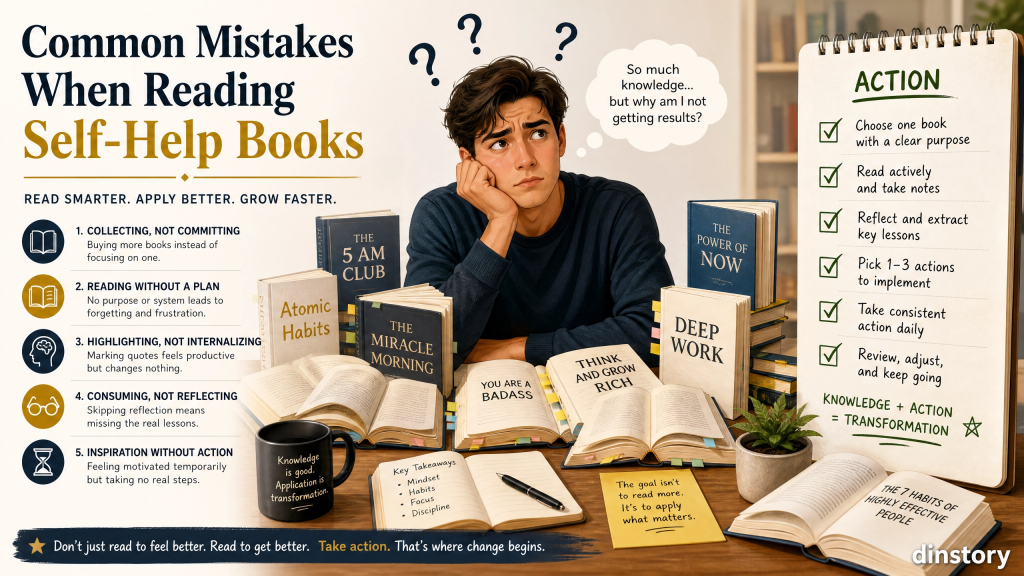
Common Mistakes When Reading Self-Help Books and How to Implement Actions
Jun
1. Introduction: Deconstructing Common Mistakes When Reading Self-Help Books and How to Implement Actions
In the vast, historically rich, and deeply transformative realm of written language, the act of reading serves as the ultimate bridge between human consciousness and collective knowledge. Throughout centuries of human civilization, books have stood as the premier vessels for preserving complex philosophical movements, passing down intricate historical narratives, and exploring the boundless boundaries of creative imagination. Today, we are embarking on a highly detailed, analytical exploration centered directly on Common Mistakes When Reading Self-Help Books and How to Implement Actions. When we critically evaluate the parameters of the Reading Self-Help Books, we are not merely discussing ink on paper or digital pixels on an e-ink display; we are dissecting the profound cognitive architectures, structural literary frameworks, and cultural currents that define how written information shapes our minds, societies, and behaviors. This professional-grade guide will break down the low-level mechanics of the hidden traps of passive reading consumption and the psychological frameworks required to execute actionable growth, providing you with an extensive masterclass in modern literary curation, active consumption, and thematic analysis.
2. Historical Context and the Structural Evolution of Text
To fully comprehend the deep structural mechanisms behind the Reading Self-Help Books, one must first analyze the historical trajectory of textual evolution and the democratization of literature. From ancient clay tablets and hand-copied papyrus scrolls to the revolutionary invention of Gutenberg’s movable type printing press, the physical format of the book has continually dictated how information is processed and preserved. The modern conversation surrounding Common Mistakes When Reading Self-Help Books and How to Implement Actions represents the absolute zenith of this long-term evolution. Historically, books were rare, luxury artifacts reserved exclusively for the societal elite, which heavily concentrated intellectual authority. As manufacturing processes became highly industrialized, the written word was liberated, sparking massive shifts in global literacy, cultural revolutions, and the birth of distinct literary genres. Understanding this rich foundational background allows modern readers to perceive every text not as a sterile, isolated object, but as a living, breathing artifact deeply connected to decades of socio-cultural development and mechanical innovation.

3. Technical Deep Dive: Narrative Architecture and Textual Mechanics
Moving beyond the historical canvas, let us execute a rigorous technical deep dive into the raw engineering of narrative architecture that underpins the Reading Self-Help Books. At the absolute lowest level, a masterpiece of writing functions much like a sophisticated software ecosystem or a high-end architectural blueprint. Every word choice, syntactic rhythm, structural pacing decision, and thematic layer must be calculated with extreme precision to guide the reader’s cognitive focus. When evaluating the structural logic of Common Mistakes When Reading Self-Help Books and How to Implement Actions, literary analysts must deconstruct the subtle mechanics of character development matrices, plot arc geometries, and subtextual layers. The friction between opposing ideas, the carefully controlled drip-feed of critical information, and the deliberate manipulation of narrative perspective all combine to execute a calculated psychological feedback loop. This structural rigor is precisely what distinguishes mass-market, forgettable prose from enduring, paradigm-shifting literature that retains its analytical potency across generations of readers.
4. Cognitive Engineering: How Reading Self-Help Books Rewires the Human Mind
The act of reading is a highly demanding cognitive event that physically alters the neurobiology of the human brain, making cognitive science a critical pillar of the Reading Self-Help Books discussion. Neuroscientists utilizing advanced fMRI scanning technology have conclusively demonstrated that deep engagement with written language maps complex neural pathways, drastically increasing neuroplasticity and white matter connectivity across both hemispheres. When a reader deeply immerses themselves in the thematic world of Common Mistakes When Reading Self-Help Books and How to Implement Actions, the brain’s somatosensory cortex actively simulates the physical sensations described in the prose, effectively treating the reading experience as a real-world lived event. Furthermore, text consumption serves as an elite psychological gym, building complex networks for verbal memory, critical logical reasoning, and advanced emotional empathy. By understanding these low-level cognitive engineering mechanisms, we realize that choosing what we read is directly choosing how we physically rewire our brain’s architecture over time.
5. Sensory Mapping: The Intersection of Ambiance, Environment, and Text
One absolutely cannot optimize the performance of written consumption without dedicating immense analytical attention to the environmental and sensory mapping surrounding the text. The physical ambiance of your reading space—dictated by acoustic decibel levels, optical lighting warmth, ergonomic seating postures, and even tactile material textures—heavily influences your brain’s ability to enter a state of ‘deep reading.’ When tailoring an environment to complement the themes of Common Mistakes When Reading Self-Help Books and How to Implement Actions, the objective is to eliminate digital cognitive distractions while amplifying focus. A soft, warm light reduces optical strain, while a quiet acoustic profile allows the working memory to fully absorb complex syntactical structures without constant mental interruptions. The deliberate curation of your reading environment directly dictates your cognitive retention rate, transforming the casual consumption of the Reading Self-Help Books into a deeply meditative, hyper-focused intellectual ritual that maximizes structural comprehension.
6. The Curation Ecosystem: Organizing and Building an Intellectual Sanctuary
The true brilliance of a sophisticated literary lifestyle lies in your long-term curation philosophy and library organization architecture. The books you choose to surround yourself with act as a physical materialization of your intellectual journey and personal growth. In the context of managing a collection focused on the Reading Self-Help Books, organization should move beyond basic alphabetical alignment and into intentional psychological curation. Grouping books by thematic synergies, structural complexity, or active research fields turns your personal library into a highly efficient, spatial external memory drive. Mainstream consumer culture encourages the thoughtless accumulation of material objects, but true bibliophiles practice strict, conscious curation. Every volume in a collection optimized for Common Mistakes When Reading Self-Help Books and How to Implement Actions should serve a distinct purpose—either acting as a reliable repository of foundational data, a challenging intellectual exercise, or an intimate source of aesthetic and philosophical inspiration that continuously expands your worldview.
7. Comparative Analysis: Legacy Publishing vs. Modern Digital Mediums
To fully contextualize the value and current state of the Common Mistakes When Reading Self-Help Books and How to Implement Actions, we must place it in direct, unflinching comparison with competing media ecosystems and modern consumption models. How exactly does deep textual engagement stack up against short-form algorithmic digital content or passive video consumption? The contrast is stark. Mass-market digital content is engineered specifically to exploit the brain’s dopamine pathways via rapid micro-stimuli, resulting in fragmented attention spans and shallow cognitive processing. Conversely, the structured text of the Reading Self-Help Books demands sustained linear focus, building long-term intellectual endurance and analytical depth. When analyzing traditional print publishing against modern e-ink or audio alternatives, we see distinct pros and cons regarding spatial memory mapping versus hyper-portable utility. Ultimately, the modern reader must build a balanced, hybrid media framework that leverages technological convenience without sacrificing the irreplaceable cognitive retention of print.
8. Strategic Maintenance: Preserving the Physical and Digital Artifact
A high-end literary collection engineered around the strict principles of the Reading Self-Help Books represents a massive investment of your financial resources and personal time, making a strict maintenance protocol non-negotiable. For physical books, environmental factors like relative humidity, direct UV light exposure, and acid paper migration are constant structural threats. To ensure long-term artifact persistence, physical volumes must be kept in climate-controlled environments away from direct sunlight, which degrades bindings and yellows pages. For digital libraries interacting with the parameters of Common Mistakes When Reading Self-Help Books and How to Implement Actions, strategic maintenance involves managing metadata, organizing local backup files, and ensuring open-source formats that protect your digital ownership against corporate server shutdowns. Treating your library with strict hardware stewardship ensures that these vital stores of human knowledge remain completely uncompromised for future generations.
9. Conclusion: Mastering the Literary Landscape
In conclusion, our exhaustive, multidisciplinary exploration into the architecture of the Common Mistakes When Reading Self-Help Books and How to Implement Actions clearly proves that the written word remains the single most powerful tool for human self-optimization and cognitive growth. The Reading Self-Help Books is definitely not just a passive hobby or a temporary escape from daily routines; it is a highly calculated, deeply rewarding methodology for mastering the digital interface of your mind, expanding your intellectual horizons, and safeguarding your mental clarity. Reject the shallow, fragmented information ecosystem of modern algorithms, and intentionally embrace the deep, linear focus demanded by elite literature. Experiment with diverse genres, maintain strict library curation standards, and transform your personal workspace into a true sanctuary of high performance. The ultimate library is an architectural masterpiece of your soul that you curate, refine, and perfect over a lifetime. Welcome to the final, profoundly life-changing frontier of the elite enthusiast reading experience.
