
Post
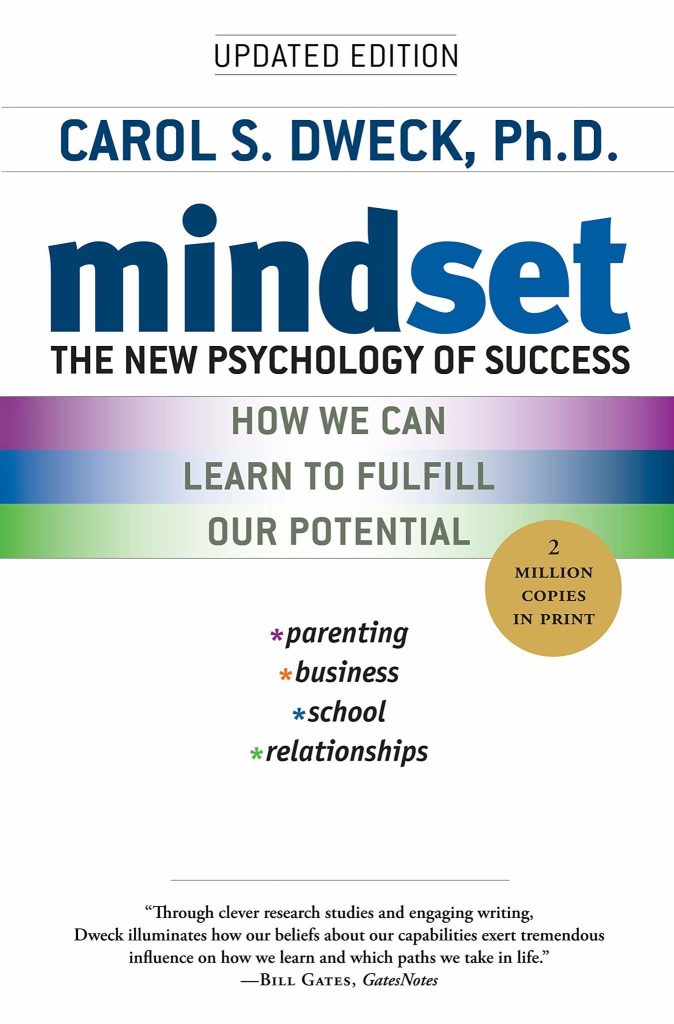
Mindset – The New Psychology of Success 2026
May
Mindset – The New Psychology of Success 2026
Mindset: The New Psychology of Success by Carol S. Dweck is a groundbreaking book published in 2006 that has fundamentally changed how educators, parents, coaches, athletes, and business leaders think about talent, achievement, and personal development.
Based on decades of rigorous psychological research, Dweck, a Stanford University professor, introduces the concept of two contrasting mindsets — the fixed mindset and the growth mindset — and demonstrates how they profoundly influence every area of life.
The book argues that our beliefs about our own abilities and intelligence shape our motivation, resilience, and ultimate success far more than our actual talent or IQ. It is not just another self-help title; it is a well-documented psychological framework backed by experiments, real-life stories, and practical strategies that have been adopted in schools, corporations, and sports teams worldwide.
The Two Mindsets: Fixed vs. Growth
At the heart of the book is a simple but powerful distinction:
- Fixed Mindset: People believe that their basic qualities — intelligence, talent, personality, and abilities — are static and unchangeable. Success is seen as proof of natural intelligence, while failure or struggle is interpreted as evidence of inadequacy. Individuals with a fixed mindset tend to avoid challenges, give up easily when obstacles arise, ignore useful feedback, and feel threatened by the success of others.
- Growth Mindset: People believe that abilities and intelligence can be developed through dedication, hard work, learning, and perseverance. Challenges are exciting opportunities for growth. Failure is not a condemnation of worth but a valuable source of information. Setbacks are seen as temporary and surmountable. People with this mindset embrace effort, learn from criticism, and find inspiration in the success of others.
Dweck emphasizes that these mindsets are not permanent personality traits. Everyone has a mixture of both, and they can shift depending on the situation. The goal is to recognize fixed-mindset triggers and consciously cultivate a growth-oriented approach.
The Power of Praise and Self-Perception
One of Dweck’s most influential insights concerns praise. In a famous study, students who were praised for being “smart” (person praise) were more likely to develop a fixed mindset. When faced with difficulty, they avoided challenges and lost confidence. In contrast, students praised for their effort and strategies (process praise) showed greater persistence, enjoyment, and performance.
This has massive implications for parenting and education. Telling children “You’re so smart!” can inadvertently make them fragile. Saying “You worked really hard on that” encourages resilience and a love of learning.
Real-World Applications Across Domains
Dweck devotes chapters to how mindsets operate in different areas of life:
Education: Students with a growth mindset see school as a place to develop their brains.
They recover better from poor grades and are more likely to embrace difficult subjects. Fixed-mindset students often cheat, avoid hard classes, or give up when they hit their first academic wall.
Business and Leadership: CEOs with fixed mindsets often create toxic cultures of genius and blame. They surround themselves with yes-people and hide weaknesses. Growth-mindset leaders, like those at companies that embrace learning from failure, foster innovation and adaptability. Dweck contrasts the decline of Enron (fixed-mindset culture) with more resilient organizations.
Sports: Star athletes like Michael Jordan and Tiger Woods (in his early career) exemplified growth mindsets — they treated every setback as fuel for improvement. Many talented athletes with fixed mindsets flame out when they encounter slumps or younger competitors.
Relationships: In personal relationships, a fixed mindset leads people to believe partners are either compatible or not — with no room for growth. A growth mindset encourages couples to work through problems, view conflicts as opportunities to improve, and believe that relationships can be nurtured.
Personal Development: The book includes inspiring stories of people who transformed their lives by shifting mindsets, from struggling students to executives who learned to embrace feedback.
The Journey from Fixed to Growth
Dweck is careful to note that changing mindsets is not easy. Fixed-mindset triggers — such as facing criticism, experiencing failure, or watching others succeed — can activate defensive responses. She offers practical strategies:
- Learn to hear the fixed-mindset voice (“I’m not good at this”) and reframe it with growth language (“I’m not good at this yet”).
- Focus on the process: effort, strategies, and learning.
- View challenges as opportunities rather than threats.
- Use “yet” to shift from judgment to potential.
- Seek honest feedback and surround yourself with growth-minded people.
The book includes self-assessment tools and real exercises readers can apply immediately.
Criticisms and Nuances: Mindset – The New Psychology of Success 2026
While Mindset has been enormously influential, it is not without criticism. Some researchers argue that Dweck’s early claims about the impact of mindset interventions were overstated, and large-scale replication studies have shown mixed results. Simply telling students to have a growth mindset is often insufficient without broader systemic changes in teaching methods and school culture.
Others note that the book sometimes presents mindsets in overly binary terms, though Dweck herself acknowledges the spectrum. There is also debate about how much mindset can overcome structural inequalities, poverty, or severe learning challenges. A growth mindset is powerful, but it is not a complete substitute for resources, opportunity, or support.
Despite these points, the core idea remains robust and has inspired thousands of studies in psychology and education.
Why Mindset Matters More Than Ever in 2026
In today’s fast-changing world driven by AI, automation, economic uncertainty, and rapid technological disruption, the ability to learn, adapt, and reinvent oneself is critical. Fixed-mindset thinking — believing your skills are set in stone — is becoming a major liability when entire industries transform every few years.
Parents worry about raising resilient children in a high-pressure, comparison-filled social media environment. Educators seek ways to motivate students facing unprecedented academic and mental health challenges. Companies need employees and leaders who can learn from failure rather than hide mistakes in an era of constant innovation.
Dweck’s framework offers a psychological foundation for lifelong learning. It counters the toxic “natural genius” myth promoted by some hustle-culture narratives and provides a healthier alternative to burnout and perfectionism.
The growth mindset aligns beautifully with modern concepts like deliberate practice, resilience training, and neuroplasticity research, which shows the brain’s remarkable ability to change and grow throughout life.
Key Takeaways You Can Apply Today
- Intelligence and abilities are not fixed — they can be developed.
- Embrace challenges and view failure as feedback.
- Praise effort and strategies, not innate talent.
- Replace “I can’t” with “I can’t yet.”
- Learn from criticism instead of defending against it.
- Find inspiration in others’ success rather than feeling threatened.
- Cultivate a growth environment at home, work, and school.
Mindset is ultimately an empowering and hopeful book. Carol Dweck shows that personal transformation does not require superhuman talent — it requires a shift in how we interpret our experiences. By adopting a growth mindset, we free ourselves from the tyranny of constant validation and open the door to genuine development, deeper relationships, and greater achievement.
Whether you are a student struggling with academics, a professional navigating career changes, a parent raising children, or an athlete chasing excellence, this book provides a clear, research-based path forward. It reminds us that our potential is not predetermined — it is something we build, day by day, through the power of belief and persistent effort.
In a world that increasingly rewards adaptability and continuous learning, Mindset remains one of the most practical and transformative books of the 21st century. Changing your mindset may be the single highest-leverage improvement you can make in your life.
