
Post
Best Homo Deus – A Brief History of Tomorrow 2026
May
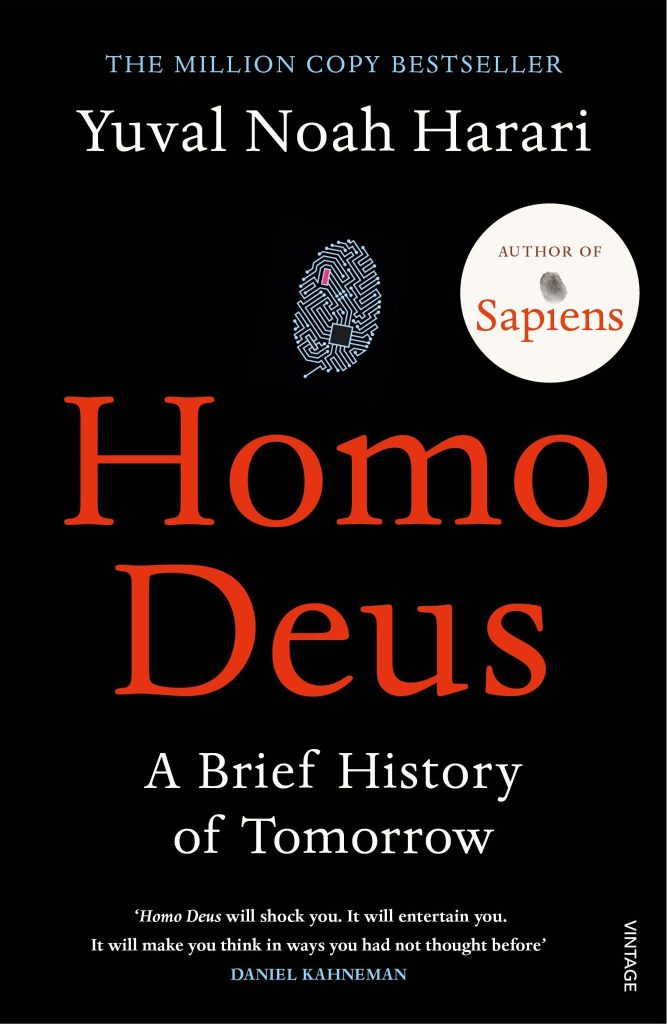
Homo Deus: A Brief History of Tomorrow by Yuval Noah Harari is a bold, speculative, and often unsettling sequel to his global bestseller Sapiens. Published in 2015 (Hebrew) and 2016 (English), the book shifts from examining humanity’s past to forecasting its possible futures. While Sapiens explained how Homo sapiens conquered the world through shared myths and fictions, Homo Deus (“Man God”) asks what happens next as science and technology grant us god-like powers over life, death, and consciousness itself.
Harari argues that the 21st century will see humanity upgrade into something new. We are on the verge of breaking free from the tyranny of natural selection, famine, plague, and war—only to face new challenges: meaninglessness, inequality between enhanced and non-enhanced humans, and the rise of non-conscious but highly intelligent algorithms. The book is not a conventional futurology text filled with predictions about gadgets. Instead, it is a philosophical meditation on power, religion, economics, and biology in the coming decades.
The End of the Humanist Era
Harari begins by declaring that the dominant religion of the modern era—humanism—is crumbling. Humanism, which places humans and their feelings at the center of the universe, powered liberalism, democracy, capitalism, and the arts for the past few centuries. It told us that the customer is always right, that voter feelings matter, and that individual free will and personal experience are sacred.
Yet science is undermining this worldview. Advances in neuroscience, biology, and computer science increasingly show that free will is an illusion, consciousness is a biochemical process, and organisms (including humans) are algorithms. If humans are biochemical algorithms, then non-conscious algorithms (AI) may soon outperform us in almost every domain—from driving and diagnosing diseases to composing music and making political decisions.
As humanism loses credibility, new “techno-religions” are emerging to fill the vacuum.
The New Human Agenda: Immortality, Bliss, and Divinity: Homo Deus – A Brief History of Tomorrow
Harari identifies three major projects that will define the 21st century:
- Immortality — Defeating death. Harari notes that for most of history, death was seen as inevitable and even meaningful. Today, many scientists and Silicon Valley visionaries treat death as a technical problem to be solved. Companies and researchers are working on stopping aging, regenerating organs, and uploading consciousness. “Death is optional,” some claim.
- Bliss — Achieving perpetual happiness. With advances in biotechnology and neuroscience, we may soon engineer bodies and brains that experience constant well-being, eliminating depression, anxiety, and suffering. This raises philosophical questions: Would engineered happiness still be authentic? Would we lose something essential about the human condition?
- Divinity — Upgrading humans into gods. Through genetic engineering, cyborg enhancements, and brain-computer interfaces, a small elite may evolve into a new species of superhumans with superior intelligence, longevity, and capabilities. This could create unprecedented biological and social inequality—far greater than anything seen before.
Harari warns that these projects will not benefit all of humanity equally. A widening gap may emerge between the upgraded “superhumans” and the rest, potentially rendering large populations economically and militarily useless.
Dataism: The Rising Religion
One of the book’s most influential and provocative ideas is Dataism—an emerging belief system that views the entire universe as a flow of data. In this worldview, organisms are seen as biochemical algorithms, and value comes from processing data efficiently. Internet giants, governments, and corporations are already building systems that collect massive amounts of personal data to predict and influence behavior.
Under Dataism, individual humans may lose their sacred status. If algorithms can understand and predict us better than we understand ourselves, decisions about our lives—careers, relationships, health—may be outsourced to AI. Harari paints a chilling yet plausible scenario where most humans become part of a vast data-processing network, while a small technocratic elite (or the algorithms themselves) hold real power.
He contrasts this with traditional humanism: instead of “listen to your feelings,” the new mantra becomes “listen to the algorithm.”
Biotechnology, AI, and the Future of Work and War
Harari explores how biotechnology and information technology will merge. Gene editing (CRISPR), brain-computer interfaces (like Neuralink), and artificial intelligence are converging rapidly. These tools could solve many problems but also create new ones:
- Mass unemployment: Intelligent algorithms may replace humans in most professions, including creative and intellectual ones.
- Surveillance states: Authoritarian regimes could use data to create unprecedented social control.
- New wars: Conflicts may revolve around control of data and the ability to hack human bodies and minds.
- Loss of meaning: As machines outperform humans, many people may struggle to find purpose, leading to psychological and social crises.
Harari is careful not to claim these futures are inevitable. He presents them as possibilities based on current trajectories, urging readers to make conscious choices about the kind of future we want.
Criticisms and Limitations
Homo Deus has been both celebrated and criticized. Supporters praise its big-picture thinking, provocative questions, and ability to synthesize ideas from multiple disciplines. Critics argue that Harari sometimes overstates scientific certainty (particularly around consciousness and free will), relies on speculation rather than evidence for future claims, and underestimates human adaptability and the resilience of liberal values.
Some philosophers and scientists contend that he dismisses the depth of human consciousness and subjective experience too easily. Others note that his treatment of possible futures can feel deterministic or overly pessimistic. Additionally, events since 2016—such as the rapid rise of generative AI, geopolitical tensions, and shifting attitudes toward technology—have both validated and complicated some of his predictions.
Why Homo Deus Matters in 2026
Nearly a decade after publication, Homo Deus feels remarkably prescient in 2026. Artificial intelligence has advanced faster than many expected, with large language models and multimodal systems demonstrating capabilities that blur the line between human and machine performance. Gene-editing technologies are maturing, longevity research is booming, and debates about data privacy, algorithmic bias, and AI alignment dominate global discourse.
The book helps readers make sense of current headlines: the race for AGI, concerns about job displacement, ethical battles over embryo selection and brain implants, and the growing power of tech platforms. It also provides a framework for thinking about emerging ideologies and the potential “Dataist” transformation of society.
In an era of rapid change, Homo Deus encourages long-term, philosophical thinking rather than short-term reactivity. It forces us to ask fundamental questions: What kind of beings do we want to become? What values should guide technological development? Who gets to decide?
Key Takeaways
- Humanism is declining as science reveals humans as biochemical algorithms.
- The 21st century’s big projects are immortality, bliss, and divinity.
- Dataism may replace humanism as the dominant belief system.
- Tremendous power is coming, but so are unprecedented inequality and existential questions.
- The future is not predetermined—we still have time to shape it through conscious choices and ethical frameworks.
Homo Deus is ultimately a call for wisdom alongside power. Harari does not offer easy optimism or doom-mongering. Instead, he presents a clear-eyed view of the forks in the road ahead. As our species gains divine abilities, we must decide what kind of gods we wish to be.
For anyone interested in technology, philosophy, ethics, politics, or the future of work and society, Homo Deus is essential reading. It complements Sapiens beautifully: once you understand where we came from, you are better equipped to influence where we are going. In a world racing toward superintelligence and human enhancement, Harari’s big questions may prove more important than any specific prediction he makes.
The book leaves readers both exhilarated and uneasy—a fitting response to an era in which Homo sapiens stands on the threshold of becoming Homo deus.
