
Post
Sapiens – A Brief History of Humankind
May
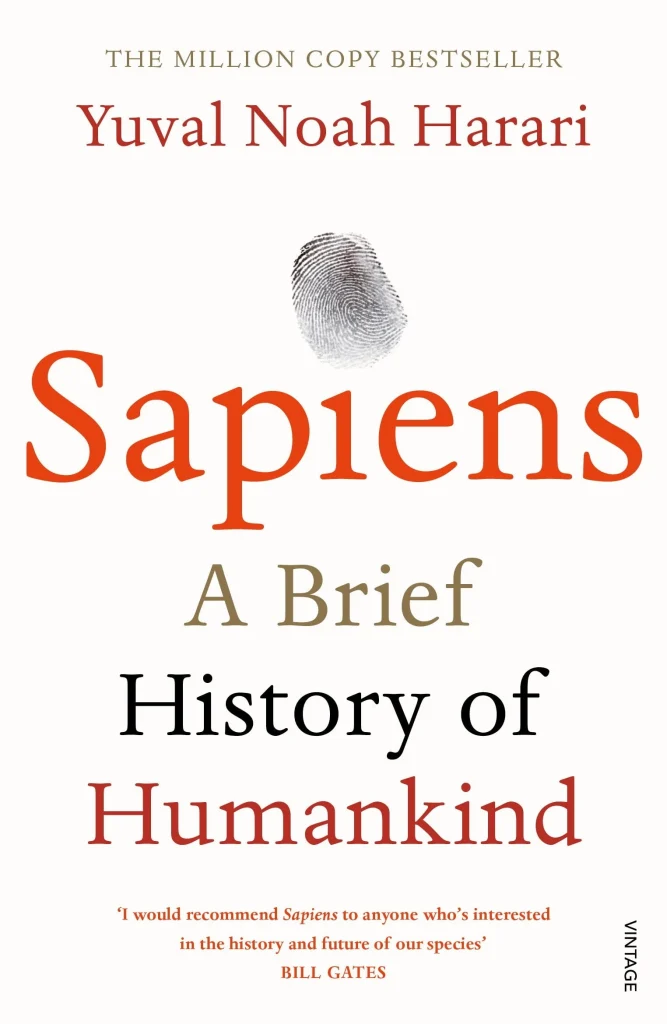
Sapiens: A Brief History of Humankind by Yuval Noah Harari is a sweeping, provocative, and immensely popular account of human history from the emergence of Homo sapiens to the present day—and beyond. First published in Hebrew in 2011 and in English in 2014, the book has sold over 25 million copies worldwide and transformed how millions of readers understand their place in history. Harari, a historian at the Hebrew University of Jerusalem, combines vast scholarship, bold speculation, and engaging storytelling to argue that our species’ dominance stems not primarily from superior intelligence or tool-making, but from our unique ability to create and believe in shared fictions.
Sapiens is neither a conventional history textbook nor a dry academic treatise. It is a grand narrative that challenges cherished assumptions about progress, happiness, religion, money, empire, and the very nature of humanity. Harari’s central thesis is that what made Homo sapiens exceptional was the Cognitive Revolution around 70,000 years ago, when we developed the capacity for flexible, large-scale cooperation through myths and stories.
The Cognitive Revolution: The Power of Fiction
Harari divides human history into four major revolutions. The first, the Cognitive Revolution, enabled sapiens to invent language capable of discussing things that do not exist—gods, nations, corporations, human rights, and money. These “intersubjective realities” or shared myths allow millions of strangers to cooperate effectively.
Unlike Neanderthals or other human species, sapiens could say, “This piece of paper is worth a week’s food” or “This land belongs to our tribe because the gods decreed it.” These fictions gave sapiens a decisive advantage, allowing them to form larger groups, plan complex operations, and outcompete other humans. Harari provocatively suggests that the Cognitive Revolution also enabled sapiens to spread across the globe and drive other human species to extinction.
The Agricultural Revolution: History’s Biggest Fraud?
One of the book’s most controversial sections labels the Agricultural Revolution (starting around 12,000 years ago) as “history’s biggest fraud.” While it allowed for explosive population growth and the rise of cities and empires, Harari argues it was a disaster for individual human well-being. Hunter-gatherers often enjoyed more varied diets, more leisure time, and greater social equality. Farmers worked longer hours, suffered from malnutrition, disease, and rigid hierarchies.
Yet once agriculture began, there was no turning back. Population growth created pressure that made foraging unsustainable. Harari writes, “We did not domesticate wheat. It domesticated us.” This idea challenges the traditional narrative of progress as an unalloyed good.
The Unification of Humankind: Sapiens – A Brief History of Humankind
Harari traces how shared myths gradually unified the world. Money, empires, and universal religions became the three great unifiers.
- Money is the most universal and egalitarian fiction ever invented. It allows perfect strangers to cooperate on complex projects because both believe in its value.
- Empires spread ideas, languages, and cultures, often brutally, but unintentionally creating larger networks of cooperation.
- Religions (including secular ones like communism or liberalism) provided overarching stories that justified laws, morality, and social order.
By the early modern period, these forces had created a global system. Harari notes that while history is full of suffering and exploitation, the direction of travel has been toward larger and larger circles of cooperation.
The Scientific Revolution and the Modern Age
The final major turning point began around 500 years ago with the Scientific Revolution. What made it unique was the willingness to admit ignorance and the marriage of science with imperialism and capitalism. This combination produced unprecedented growth in power and wealth.
Harari explores how capitalism became a dominant myth because it incentivizes reinvestment of profits into production. He examines the rise of modern ideologies—liberalism, socialism, nationalism—and treats them as competing religions. He also examines the darker sides of modernity: European imperialism, industrial-scale war, and ecological destruction.
A recurring theme is the gap between objective reality and human happiness. Harari argues that despite dramatic increases in material wealth, violence, and lifespan, there is little evidence that people are significantly happier than their ancestors. Happiness seems more dependent on expectations and biology than on absolute conditions.
Biotechnological and Information Revolutions: What Next?
In the final chapters, Harari peers into the future. He suggests we are on the brink of new revolutions in biotechnology and information technology. Humans may soon upgrade themselves into gods—gaining control over life, death, and even consciousness—or create algorithms that know us better than we know ourselves.
He introduces the idea of Dataism, a possible emerging religion in which the flow of information becomes the highest value. In this worldview, humans might become superfluous as data-processing systems.
Strengths and Criticisms
Sapiens excels at making complex ideas accessible and forcing readers to reconsider their worldview. Harari’s ability to connect disparate fields—biology, anthropology, economics, and philosophy—into a coherent story is masterful. The book is witty, provocative, and often deeply humane in its concern for suffering.
However, it has faced substantial academic criticism. Historians and scientists argue that Harari oversimplifies, cherry-picks evidence, or presents speculative ideas as established fact. Some claim his treatment of the Agricultural Revolution ignores regional variations and nutritional improvements over time. Others criticize his relatively brief and sometimes dismissive treatment of culture, art, and individual agency. His predictions about the future are seen by some as overly deterministic or sensationalist.
Despite these critiques, the book’s influence is undeniable. It has shaped public discourse on everything from politics and technology to animal rights and meaning in life.
Why Sapiens Matters in 2026
In 2026, amid rapid advances in artificial intelligence, gene editing, climate change, and geopolitical tensions, Harari’s big-picture perspective feels more relevant than ever. His warnings about the power of fictions help us navigate polarized politics, algorithmic manipulation, and emerging ideologies. His discussion of happiness amid material progress resonates in an age of rising anxiety and mental health challenges despite technological abundance.
The book also raises urgent ethical questions about the future of humanity. As AI systems become more capable and biotechnology blurs the line between human and machine, understanding the myths that bind us becomes essential for making wise collective choices.
Sapiens encourages intellectual humility. By showing how much of what we take for granted—nations, corporations, gender roles, human rights—are recent cultural constructs, it invites us to imagine different possibilities for the future.
Key Takeaways
- Most of what enables large-scale human cooperation is fictional.
- “Progress” has often come at a steep cost to individual well-being and the environment.
- Happiness is more about internal expectations than external conditions.
- We are now entering an era where we can redesign life itself—biologically, psychologically, and socially.
- Understanding history’s patterns can help us make better choices about what kind of future we want to create.
Yuval Noah Harari does not offer easy answers or comfort. Instead, he provides a clear-eyed, often unsettling tour of our species’ journey. Sapiens reminds us that we are both the authors and the products of our shared stories. In a world facing unprecedented challenges and possibilities, the ability to question our myths and consciously choose better ones may be humanity’s most important survival skill.
Whether you agree with all of Harari’s conclusions or not, Sapiens will change how you see yourself, your society, and the human story. It is a rare book that makes the distant past feel immediate and the future feel urgent. In doing so, it helps us become more conscious participants in the next chapter of humankind’s brief but extraordinary history.
